



Leveraging embedded reporting features for real-time business decisions

Real-time insights have become the quiet advantage behind the success of most organizations. Why? Analytics help businesses move from a reactive stance to a proactive one when it comes to making decisions. However, business analytics shouldn’t be in a separate tool that only a few people can access. It should be readily available in the applications that teams use every day.
Enter embedded reporting. Embedded reporting is and has become a vital part of everyday business operations. Embedded reporting features real-time access to data, customizable and self-service reports, interactive dashboards, and the ability to integrate data from multiple sources. All these let end users access actionable insights within workflows, thus enhancing decision-making.
This article provides a detailed guide to embedded reporting, so read on to find out why it’s a must-have for businesses’ competitive edge.
Why real-time data matters for modern businesses
Before we dive deep into why real-time analytics are vital for organizations, let’s first answer an important question: What is embedded reporting? As the name suggests, embedded reporting is when reports and data visualization capabilities are directly integrated into a software application. So, instead of using a separate analytics tool, users see and interact with real-time data and insights within the application they’re already using.
Real-time data gives organizations visibility into whether operations are working as they should. This then improves how quickly an organization can react to internal and external changes. Teams no longer have to wait for the end of the day, week, or month to guide strategic decisions. For instance, with embedded analytics:
- Operations leaders can tell when performance changes in real time — not hours or weeks later.
- Fraud teams can detect anomalies as soon as they happen.
- Logistics managers can adjust routes based on live conditions.
- SaaS product teams can show customers up-to-date usage, spend, and system activity.
In these scenarios, embedded reports directly affect risk mitigation, cost savings, and customer satisfaction — all vital for the success of modern businesses.
How embedded reporting enables real-time insights
When real-time reporting is directly baked into existing software, everything becomes smoother for the end user. They’re not switching between tools. They’re not downloading files. They’re not asking for help to interpret anything. The data is already there if and when they need it to make informed decisions.
Behind the scenes, embedding reporting tools typically rely on:
- API-driven integrations: A platform built on APIs lets developers hook reporting functions directly into their applications. Reports refresh automatically without the need for manual exports or extra processing steps.
- Event-based pipelines: When new data arrives, event streams trigger updates and alerts instantly. This eliminates the latency that typically comes from batch refreshes.
- Live data feeds: Rather than caching information for long periods, embedded systems can draw data from multiple sources the moment it’s needed.
For developers and product teams, embedding avoids the need to build an entire reporting layer from scratch. It lets them focus on your organization’s core product capabilities while relying on proven technology that handles the heavy lifting of live data retrieval, security, and interactive exploration. For business leaders, it means decisions aren’t stalled by data gaps.
Key features of effective real-time embedded solutions
Real-time reporting works only when the underlying embedded reporting features are strong enough to support rapid data movement and high user expectations. As such, a dependable platform should include:
- Interactive dashboards and visualizations: Static charts are a thing of the past. Modern users expect to drill down into a graph, filter results on the fly, and watch their data visualizations update instantly. This self-service capability improves user experience because they can answer their own follow-up questions without relying on IT.
- Scalability and high performance: A solution that works for 10 users can crumble under 10,000. Robust reporting solutions must be built to handle large data volumes and concurrent users without slowing down. This way, speed, the core benefit of real-time reporting, is never compromised.
- Unified data view: The most powerful insights often come from connecting disparate dots. Leading platforms allow teams to combine multiple data sources—from CRM and ERP to IoT sensors—into a single, coherent, and interactive dashboard. This holistic view of data eliminates silos and provides context that is otherwise impossible to see.
- Seamless embedding and customization: The goal is for the analytics to feel like a native part of the host application. This requires white-labeling capabilities and the ability to customize the look and feel to match the company's branding perfectly, a hallmark of pixel-perfect reporting.
Real-world applications
The theoretical benefits of embedded reporting sound quite compelling. However, we can only prove its true value in practice. Luckily, there are already real-world applications that show just how embedded reporting features have revolutionized operations across industries. Some examples include:
- SaaS: For an OEM building a software product, embedding sophisticated analytics can be a powerful competitive differentiator. It increases user engagement and stickiness by allowing their customers to derive more value without ever leaving the application.
- Finance: Embedded reports provide finance teams with immediate visibility into transaction patterns, risk exposure, and portfolio movements. The closer these teams get to live updates, the faster they can secure accounts or adjust strategies.
- Logistics: Organizations in this industry can use embedded reporting to track inventory, manage fleets, and monitor supply chains in real time. This can help teams make timely decisions that save operational costs and losses.
- IoT: These systems lean heavily on real-time feeds because devices are constantly generating data. Embedded reporting turns raw events into understandable patterns, so operators can respond quickly.
In each scenario, the common thread is experience. End users want instant access to answers inside the application where the work happens. Embedded reporting features facilitate this experience without sacrificing depth, branding, or control.
Getting started with real-time embedded reporting
Embedded analytics isn’t a nice-to-have capability in today’s world of business. It’s a must-have for an organization that wants a competitive advantage. But not all embedded reporting solutions are the same. It’s essential to choose the right one. A platform that provides a simple guide to embedded reporting and makes the implementation process easy is the best bet for any organization.
Jaspersoft is that platform. Its API-first approach lets developers embed reports directly into an application’s architecture without needing to redesign an organization’s entire stack. Moreover, Jaspersoft helps prevent lock-in by allowing organizations to deploy business intelligence in any application environment, including Google Cloud, AWS, Docker, and Microsoft Azure.
Ready to discover the next generation of embedded analytics and reporting? Try Jaspersoft today.
Try Jaspersoft for free for 30 days
Efficiently design, embed, and distribute reports and dashboards at scale with Jaspersoft.
Related Resources
Unlocking the Power of Jaspersoft Dashboards
For a comprehensive understanding of Jaspersoft's rich feature set and functionalities to maximize your dashboard's potential, this webinar dives into the intricacies of data visualization, customization options, near real-time analytics, and much more to help you make data-driven decisions, streamline your workflow, and enhance your project's performance.

Ready to give it a spin?
Start your 30-day trial now.

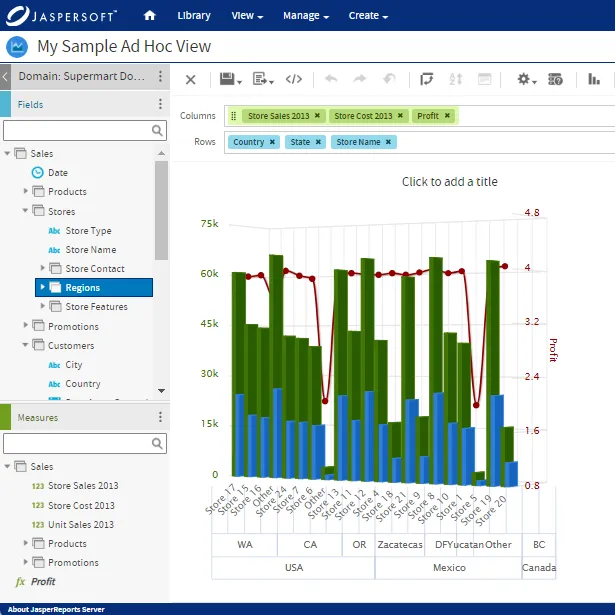
Try Jaspersoft - Free Trial
Efficiently design, embed, and distribute reports and dashboards at scale with Jaspersoft.
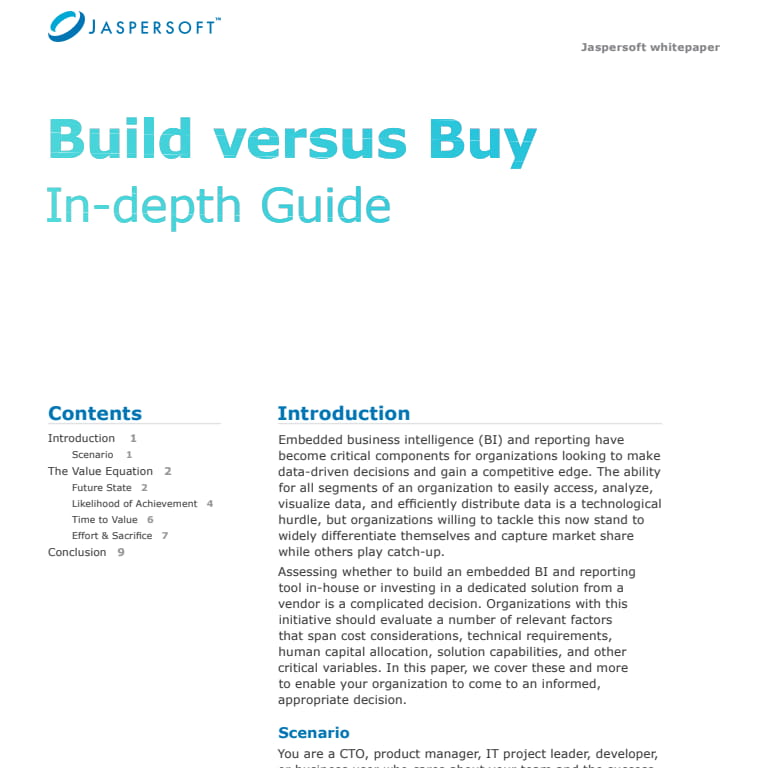
Build versus Buy: An In-depth Guide
This whitepaper provides a framework for the decision-making process and critical trade-offs between building or buying an embedded BI and reporting tool.
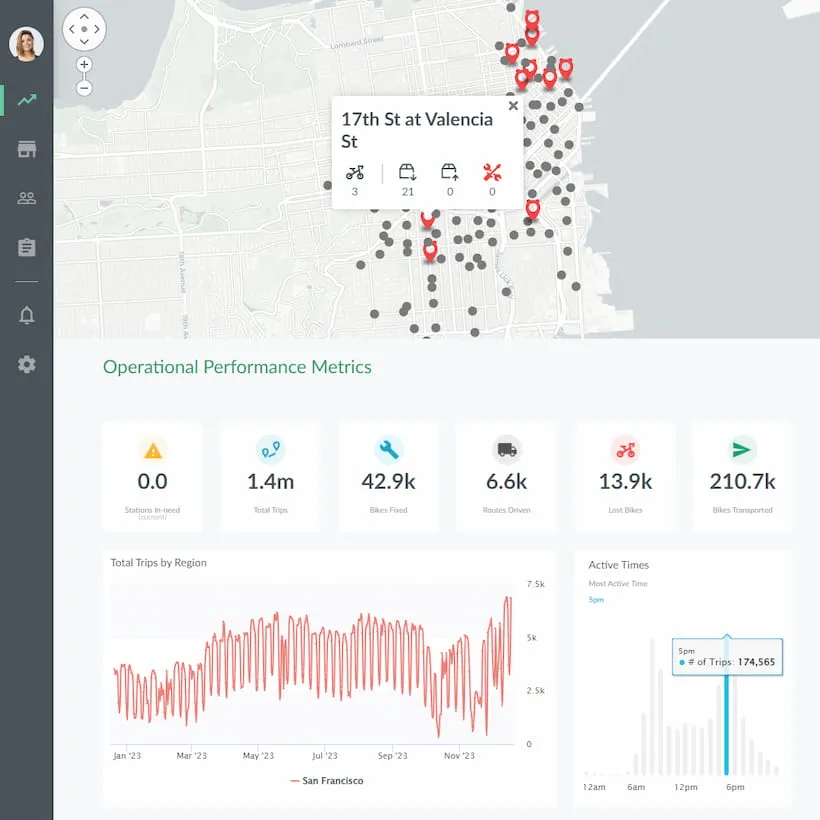
Interactive demo: Bikeshare Embedded BI, supported by Jaspersoft
Experience how to turn data into valuable insights that you and your customers can use to make better decisions.
