



Understanding software license types: What enterprise architects and OEMs must consider before embedding

Software license types play a bigger part in embedding analytics than most people realize. The terms and conditions in the software license can mean the difference between a win-win collaboration and stunted, expensive product launch. That’s because the license type governs distribution of the product, determines legal compliance, defines features that can be added, who can access the platform, and influences the application's cost structure.
If your organization is considering making the switch to embedded analytics, this guide examines the licensing features original equipment manufacturers (OEMs) and enterprise architects must take into account for a successful switch.
Why software license types matter in embedded analytics
OEM teams embedding reporting into a commercial product rely on the licenses for details on how far they can scale analytics components for the tenants and different environments. Licensing terms will also determine long-term cost control, which is one of the key factors in the build vs. buy decision framework.
Software license types will guide your design choices for system architecture and deployment. For instance, a per-seat license may force artificial user boundaries in a multi-tenant architecture and a usage-based or OEM license works better with shared services.
A software vendor that is charged per user makes it expensive to grow and generate multiple reports. Owners faced with this reality usually resort to restricting access to the platform, which stunts user adoption. Putting limits on the number of users who can access the application, which features some users can access, or what functionality some users can use, undermines the potential of a solution in the hope of saving on costs.
On the flip side, licenses designed for redistribution allow teams to deliver pixel-perfect documents and self-service ad hoc reporting, which increases customer satisfaction and improves the user experience.
Organizations that treat licensing as an afterthought rather than seeing it as a technical requirement run the risk of running into performance bottlenecks. Teams may discover too late, after implementation, that redistribution is limited or that scaling costs grow faster than revenue.
Traditional software license types and why they fall short for OEMs
Traditional software license models seem to favor internal enterprise deployments rather than considering the need for embedded analytics as a feature for real-time business decisions. These traditional one-size-fits-all solutions struggle in multi-tenant architectures and embedded environments where analytics runs as a service to power insights.
Since some licenses restrict redistribution, analytics won’t be bundled directly into customer-facing products. Teams are then forced to deploy the analytics as a separate system and raise the final price. Such licenses raise support overhead while limiting the depth of reporting integration into core workflows.
Infrastructure-based licensing is a better solution since it shifts the metric used to calculate costs for the license to cores or server capacity. This aligns better with shared services but still works under the assumption of the organization’s capacity remaining constant.
A spike in report usage can trigger unexpected license exposure, which can cause operational, financial, legal, and security consequences. This creates pressure to limit access to reports or reduce the features of a reporting software. As a consequence, operational risk increases as the product grows. Deployment flexibility shrinks across cloud and hybrid environments.
OEM-friendly licensing models for embedded and multi-tenant products
OEM-friendly licensing models are meant to match embedded analytics operations in production. Usage-based and consumption models link licensing with real system load instead of end-user counts by apportioning cost to report executions or data volume.
Capacity-oriented models are quite similar since they focus on cores or throughput ranges to facilitate flexible scaling within defined limits. These approaches enable shared services and multi-tenant architectures without forcing artificial boundaries.
Removing per-user constraints empowers teams to embed pixel-perfect and self-service reporting into workflows directly. This means end users can access analytics as a native feature rather than as an add-on. The result is improved adoption and predictable costs as tenant usage grows.
If you adopt these licensing models, there’s a good chance you will realize better product adoption and growth. Licensing tends to scale with customer value instead of ahead of it. Organizations can onboard new customers without renegotiating contracts. It also means teams can expand on the features list without setting off some hidden charges.
Redistribution rights, APIs, and modular architecture considerations
The redistribution rights allow you to embed the analytics software and deliver it in a commercial product. Licenses that restrict redistribution usually lead to weird deployment patterns, like integrating analytics with a separate license.
Legal implications of redistribution
Unclear redistribution rights can expose you to legal issues during audits. They can also limit how you deploy the software in your other businesses operating in different locations. Choose a software with a license that allows white labeling, bundling, and downstream customer access.
Technical implications of redistribution
If the license has restrictions, then you will likely be forced to make technical compromises. For example, teams may avoid shared infrastructure to stay compliant. This reduces your organization’s ability to scale the software as needed.
Team leaders need to understand that embedded analytics products depend on API-first and modular architectures. Since needs change with time, the license should allow future extensions and integrations to avoid lock-in.
How software license types shape product roadmaps and long-term cost control
Software licensing decisions can have a dramatic effect on product roadmaps and long-term costs. They determine how freely a product can evolve as usage grows and customer needs change. As for embedded analytics, the wrong license model can introduce cost risk or freeze roadmap options as adoption accelerates.
For example, Électricité de France (EDF) had a legacy SAS analytics platform. It suffered from technical obsolescence and significant licensing fees because of the perpetual license. To resolve this, EDF integrated Jaspersoft, which now serves over 80,000 annual users. Jaspersoft proved to be more cost-effective while enhancing compliance and reporting efficiency.
If organizations are to manage licensing successfully, they must align licensing agreements to real usage patterns. Licensing models that scale with consumption help avoid cost spikes as adoption grows.
Platforms like Jaspersoft work best in embedded analytics scenarios where flexible redistribution and long-term cost control are of the highest priority. Learn more about all that Jaspersoft has to offer.
Ready to give it a spin?
Start your 30-day trial now.

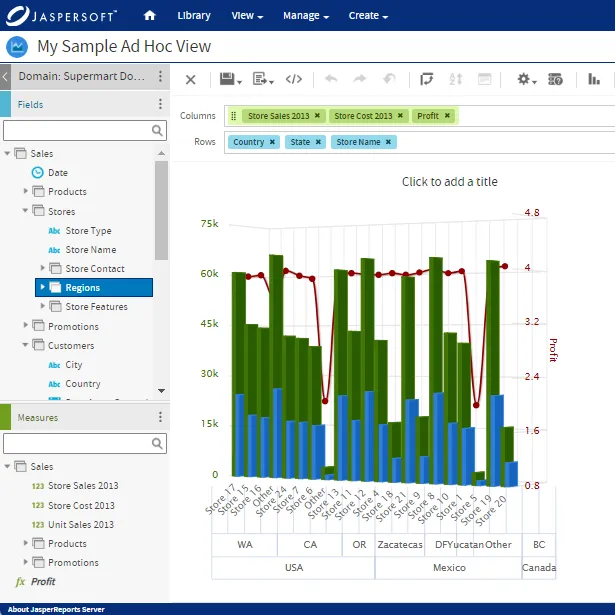
Try Jaspersoft - Free Trial
Efficiently design, embed, and distribute reports and dashboards at scale with Jaspersoft.
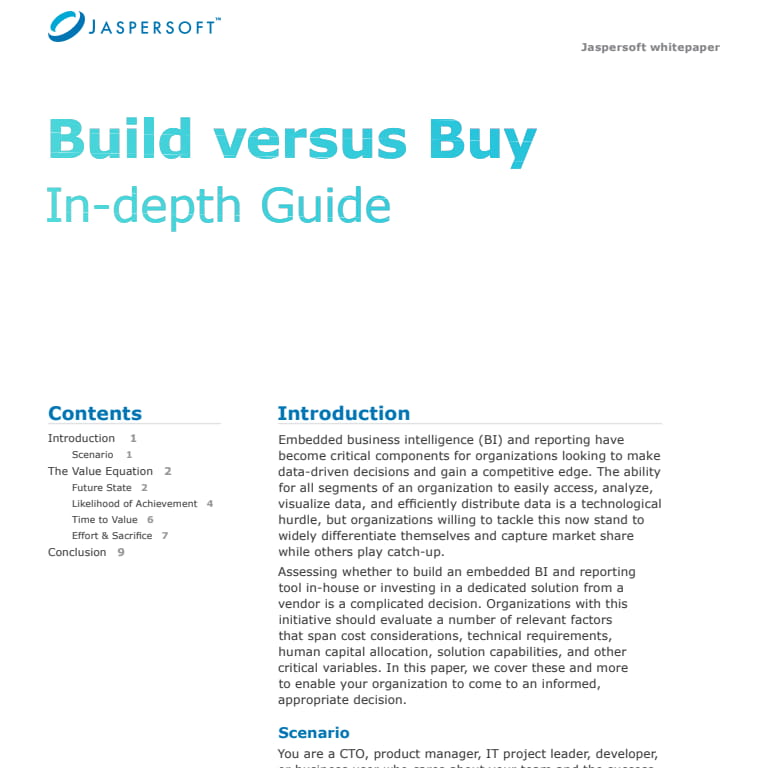
Build versus Buy: An In-depth Guide
This whitepaper provides a framework for the decision-making process and critical trade-offs between building or buying an embedded BI and reporting tool.
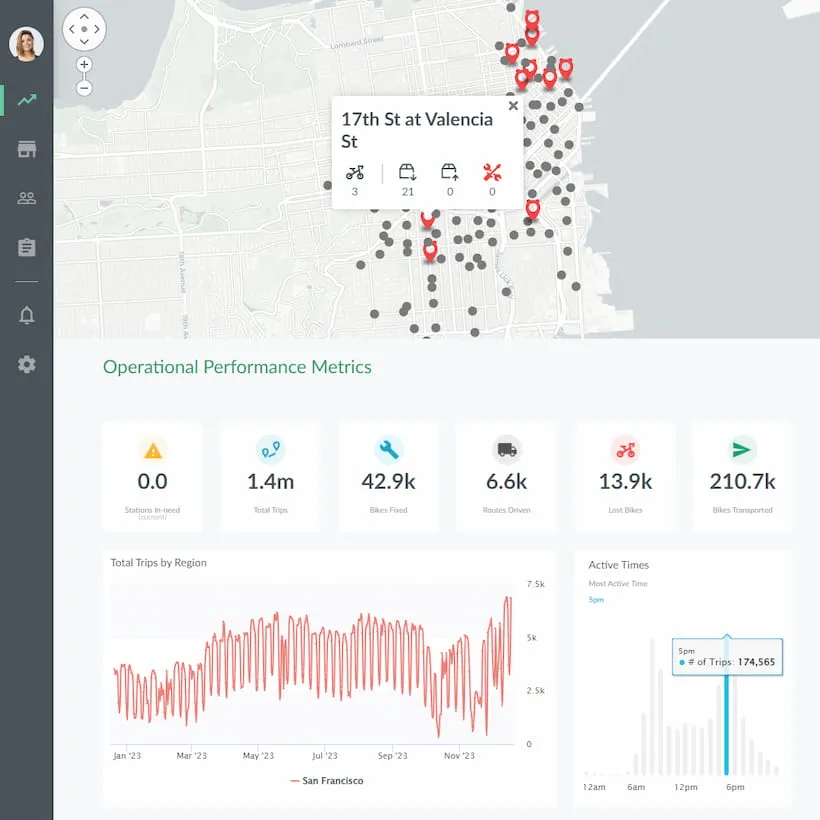
Interactive demo: Bikeshare Embedded BI, supported by Jaspersoft
Experience how to turn data into valuable insights that you and your customers can use to make better decisions.
