



Tableau vs. Jaspersoft
If you're looking for a business intelligence (BI) platform, you may have come across Tableau and Jaspersoft as popular options. Although they fall under the same category, they solve different problems.
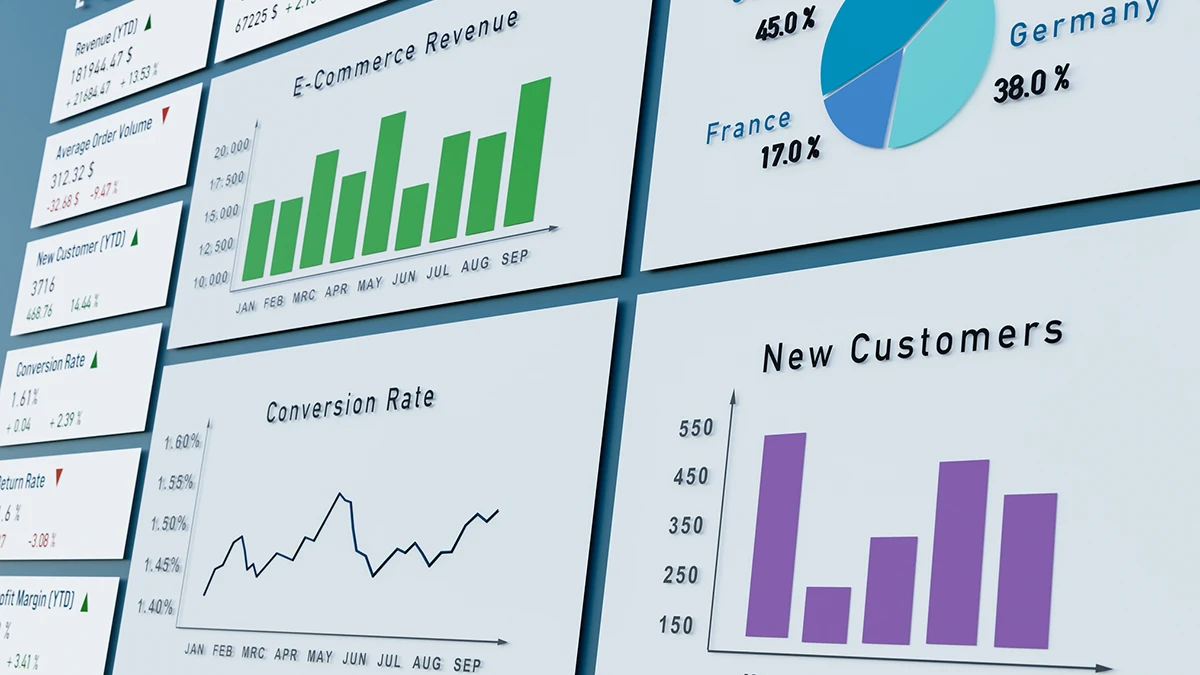
Tableau is built for exploratory data visualization, where a business user drags fields around a canvas until a pattern shows up. It's also known for its simplified customization across multiple areas, including dashboards, reports, and data notifications, and powerful visualization features including the ability to highlight and filter data, review data sets and reports through the Tableau Reader, and create "stories" with insights from different reports.
While Tableau is a powerful, intuitive tool, it’s not designed specifically for SaaS embedded analytics. It offers REST API integrations and custom web portals but lacks native multi-tenant support, often requiring teams to create workarounds. Additionally, embedding Tableau visualizations in your software for commercial use requires a Tableau Embedded Analytics license. As your business scales, per-user pricing can quickly make your embedded analytics feature a significant expense.
Jaspersoft is designed specifically for embedded analytics, making it a great choice for developers who need pixel-perfect reports and dashboards integrated seamlessly into software products at scale. These reports require accuracy, consistency, precise formatting, and automated delivery.
Read this guide to find out whether Tableau or Jaspersoft is the better choice for your needs. We’ll discuss which one helps you create smooth embedded analytics environments, break down each program’s strengths and weaknesses, compare their pricing for a growing SaaS company, and explore which is easier to integrate into your current setup.
Architecting seamless embedded analytics environments
When choosing a BI platform, you have to decide between building from scratch and buying. Usually, building from scratch allows more flexibility than buying, although it takes significantly more time and labor.
Jaspersoft narrows the gap between building and buying through its application programming interface (API)-first architecture, which lets developers pull report objects and dashboards into an application while keeping the native application's look and feel.
In contrast, Tableau provides embedding via its Embedding API, making it straightforward to add Tableau visualizations to web applications. However, the embedded visualization remains a Tableau-managed component, which can give developers less control over the surrounding experience than a more deeply integrated, API-first approach.
For a SaaS company selling to end customers under its own brand, that distinction matters significantly, since customers experience the analytics as part of your product. A visible seam undercuts that. That's why such companies should consider deploying the Jaspersoft commercial edition, which gives them the API surface to keep the product feeling like one product, not two.
Pixel-perfect reporting vs. exploratory data visualization
Some regulatory and financial reports must be rendered exactly the same way, down to the line breaks and page numbers. That's because the people reading them are often auditors, regulators, or clients who expect a formatted document, not a dashboard.
Jaspersoft was built around this pixel-perfect reporting requirement. Its report engine handles high-volume document generation with precise, repeatable formatting, including multi-tenant environments where a single report definition produces correctly formatted output for hundreds of different clients at once.
Tableau, in contrast, excels at exploratory data visualization. Think filtering, drilling down, and spotting trends across a dataset in real time — which are genuinely different jobs than embedded reporting, where the output is a fixed, formatted document rather than an environment to explore.
Scaling commercial applications with predictable licensing models
When scaling, the pricing model your platform uses determines whether your embedded analytics remains a fixed cost or becomes a moving target.
Tableau offers several licensing models for embedded analytics, including usage-based and capacity-based options, but the right model depends on the deployment and usage pattern. For a SaaS company with thousands of external users, this means carefully evaluating how Tableau's licensing structure aligns with expected analytics consumption.
Jaspersoft's original equipment manufacturer (OEM) and independent software vendor (ISV) licensing models are designed for organizations that embed and redistribute analytics within their own commercial products. Jaspersoft offers flexible licensing terms for organizations that want to include reporting, analysis, and BI capabilities in their applications, with licensing arrangements tailored to their specific needs.
Deployment flexibility and architecture agnostic integration
Deployment challenges often show up late in the process, usually after a team has committed to a platform.
They’re more common in systems with strict infrastructure requirements, like Tableau. This works fine if a company’s existing stack matches Tableau's requirements. If it doesn’t, the mismatch can lead to expensive migration work or ongoing friction between the analytics layer and the rest of the engineering stack.
For teams creating products that need to work in any environment a client already has, a system with flexible deployment and architecture-agnostic integration is key. This is Jaspersoft. It runs in the cloud, on-premise, or in a hybrid setup, and doesn’t force developers into a specific tech stack. This freedom lets development teams choose their own infrastructure instead of being stuck with someone else’s.
Choosing the right platform for enterprise reporting needs
When choosing between Tableau vs. Jaspersoft, keep in mind they aren't competing for the same job. So, the choice mostly comes down to who's using the platform and what you need it to do.
If you're a business analyst exploring internal data, looking for patterns, filtering on the fly, and building visual "stories" for a team, choose Tableau. Its interactive interface is built for exactly that kind of open-ended discovery.
If you're a developer embedding analytics into a commercial, multi-tenant product, your priorities shift. You must deliver pixel-perfect output that renders consistently across all clients. Licensing also has to stay predictable as the user base scales into the thousands. Finally, deployment has to fit whatever infrastructure your clients are already running, not the other way around. Jaspersoft was designed around all of these needs.
Curious about Jaspersoft? Learn more about it today and see how it can embed analytics and reporting directly into your application.
Ready to give it a spin?
Start your 30-day trial now.

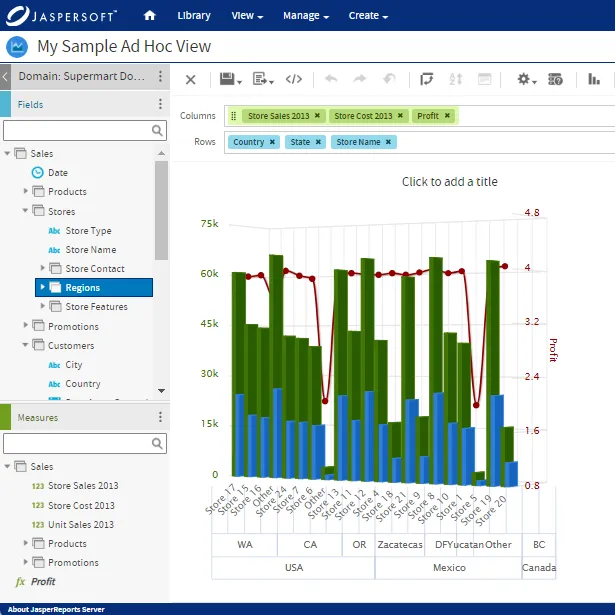
Try Jaspersoft - Free Trial
Efficiently design, embed, and distribute reports and dashboards at scale with Jaspersoft.
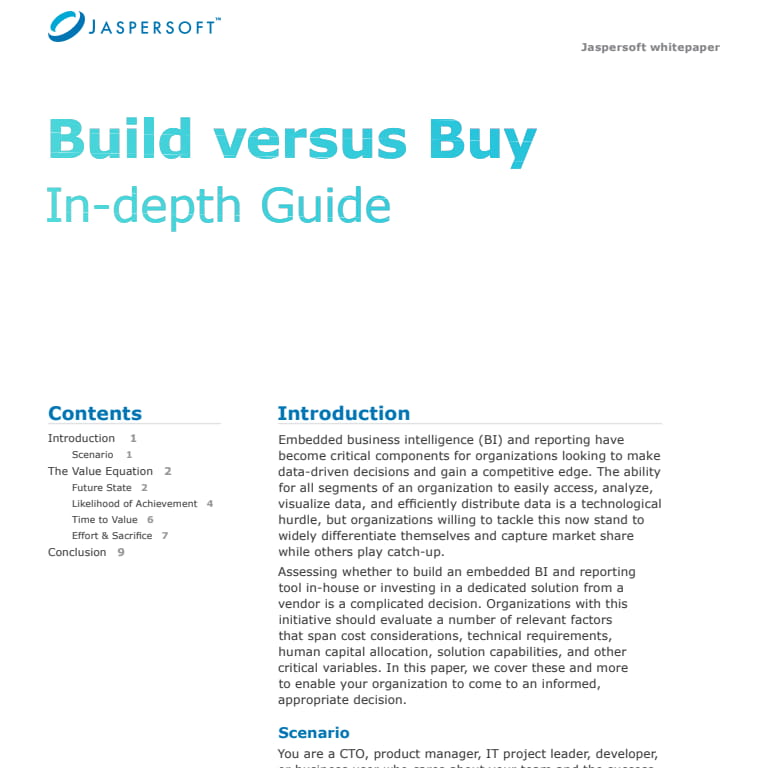
Build versus Buy: An In-depth Guide
This whitepaper provides a framework for the decision-making process and critical trade-offs between building or buying an embedded BI and reporting tool.
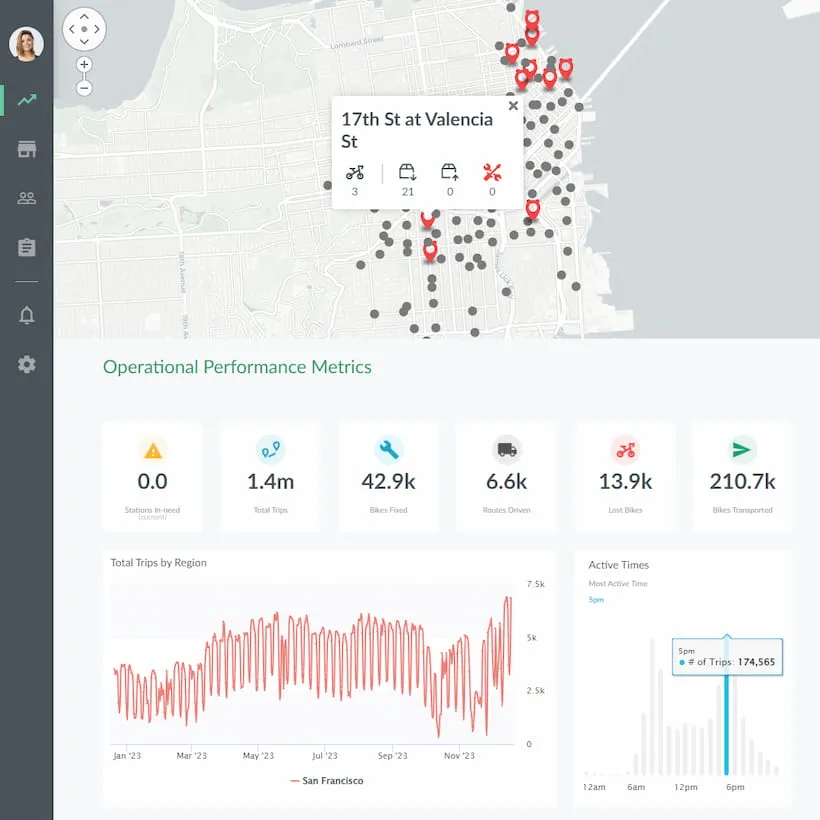
Interactive demo: Bikeshare Embedded BI, supported by Jaspersoft
Experience how to turn data into valuable insights that you and your customers can use to make better decisions.
